Tour Pricing Strategies That Increase Online Sales

Online pricing is less about “the perfect number” and more about making the decision easy while protecting margins.

1) Simplify pricing options

Too many price choices reduce conversion. Keep only what customers understand instantly:

  • Adult / child (only if relevant)
  • Private option (if you actually run it)
  • Small number of add-ons (if they are clear)

2) Use value anchors

Customers compare prices to something. Provide anchors:

  • What’s included (equipment, tastings, entry fees)
  • Duration and unique access (exclusive locations, expert guide)
  • Capacity limits (small-group experience)

3) Peak vs off-peak pricing (without confusing customers)

Seasonality is normal, but confusion kills sales.

  • Keep peak/off-peak dates visible on the calendar
  • Avoid switching prices too frequently
  • Communicate why (demand, weather windows, inclusions)

4) Offer direct-booking promos without wrecking margins

Promos should create urgency and reward direct behaviour, not permanently discount your product.

  • Use limited-time vouchers for low-demand periods
  • Partner codes for hotels/accommodation
  • Bundle value instead of discounting (extras instead of cheaper)

5) Reduce refunds with policy clarity

Refund pressure often comes from unclear expectations.

  • Show cancellation rules at checkout
  • Explain weather/minimum numbers clearly
  • Use simple, consistent time windows

6) Use capacity to protect margins

When demand is high, don’t discount. Instead:

  • Hold back seats for direct bookings
  • Offer “best availability” to direct customers
  • Use private/group options at higher margin

7) Test pricing changes safely

Don’t guess. Run controlled tests:

  • Test one variable at a time (price OR inclusions OR promo)
  • Measure conversion rate and refund rate
  • Keep a baseline you can revert to

How AddTransit helps tour operators price and sell online

  • Schedule-based departures and capacity limits
  • Promotions/vouchers (configurable)
  • Online payments and QR tickets
  • Operational tools that reduce admin and errors

Tour operator features | Tour pricing | Onboarding guide

If you want it done fast: Setup-as-a-Service.

Direct Bookings vs Online Travel Agencies (OTA) Listings — Which Is Better for Your Tours?

Most operators don’t need to “pick one”. The smart approach is to use OTAs for discovery and build direct bookings as the long-term profit engine.

What OTAs are good for

  • Discovery: customers browsing destinations
  • Filling gaps: shoulder season or last-minute seats
  • Inbound traffic: especially for new operators

What OTAs cost you (beyond commission)

  • Margin compression: commission reduces profit per seat
  • Commoditisation: you compete on price and reviews
  • Customer relationship loss: repeat business becomes harder
  • Platform risk: algorithm changes or listing issues can reduce bookings overnight

What direct bookings give you

  • Higher margin per booking
  • Control: pricing, policies, availability
  • Repeat business: you can email/remarket to customers
  • Brand strength: customers remember you, not the platform

The practical strategy: “OTA for discovery, direct for growth”

A workable model for most operators:

  1. List on a limited set of OTAs initially (avoid spreading too thin)
  2. Simultaneously build your direct booking channel
  3. Over time, shift promotions and loyalty toward direct bookings
  4. Use OTAs to fill specific low-demand periods (not as the core channel)

How to shift customers from OTA to direct (legitimately)

  • Deliver an excellent experience, then encourage “book direct next time”
  • Offer direct-only perks (priority time slots, small extras)
  • Make direct booking link easy to find everywhere
  • Partner with hotels/accommodation providers using your direct link

Where software matters

Direct bookings only work if you remove friction and run smoothly:

  • Mobile booking flow
  • Real-time availability + capacity
  • Clear policies at checkout
  • QR tickets + fast check-in

AddTransit for direct tour bookings

AddTransit is designed to build direct bookings with operational tools behind it:

  • Schedule-based capacity control
  • Online booking + payments
  • QR tickets + validation
  • Passenger manifests for staff

Tour operator features | Tour pricing | Onboarding guide

Online Booking Features Every Tour Operator Needs in 2026

Tour operators win in 2026 by removing friction, running smoother operations, and building a direct channel they control.

1) Mobile-first booking flow

Most tour discovery happens on phones. If the booking flow is slow or confusing, customers bounce.

  • Fast loading
  • Few form fields
  • Clear “what’s included” and meeting point info

2) Real-time availability and capacity control

Overbooking and manual availability tracking create refunds and staff stress.

  • Capacity per departure
  • Blackout dates
  • Seasonal schedules

3) Instant confirmation + QR tickets

Customers expect immediate confirmation. QR ticketing reduces check-in time and prevents double use.

  • Automatic confirmation messages
  • QR tickets
  • Staff validation tools

4) Clear cancellation and refund policies at checkout

The dispute prevention feature isn’t a “feature” — it’s clarity.

  • Policies displayed at checkout
  • Simple rules customers can understand quickly
  • Alignment with weather/minimum numbers realities

5) Operational tools (manifests, staff roles, day-of operations)

Tour booking software that only takes bookings creates operational chaos.

  • Passenger manifests
  • Staff roles (ticketing/support/finance)
  • Day-of views for dispatch/check-in

6) Promotions without wrecking your margins

Operators need promo capability to drive direct bookings without permanently discounting.

  • Voucher codes
  • Limited-time offers
  • Partner codes (hotels, agents)

7) Simple reporting

You need to know what’s working and what’s leaking revenue.

  • Bookings by product/departure
  • Conversion tracking (where possible)
  • Refund and cancellation patterns

8) Optional: live tracking and service updates

Not every tour operator needs this, but if you run shuttles, pickups, or time-sensitive departures, it becomes valuable.

  • Vehicle visibility for ops
  • Customer updates when things change

How AddTransit fits

AddTransit is built for operators who want direct bookings plus operational control:

  • Schedule-based inventory + capacity
  • Online booking + payments
  • QR tickets + validation
  • Optional tracking + status updates

Tour operator features | Tour pricing | Onboarding guide

How to Sell Tours Online — Step-by-Step Guide

Goal: take bookings 24/7, reduce admin, and build a direct sales channel you control.

This step-by-step guide shows you exactly how to sell tours online using clear schedules, simple pricing, and automated bookings.

Step 1: Define what you’re selling (clearly)

Online selling works when customers can quickly understand what they’re buying. Before you touch software, write down:

  • Tour name, duration, and key highlights
  • Start point / meeting point (and pickup rules if you offer them)
  • Inclusions and exclusions
  • Accessibility notes (stairs, terrain, fitness expectations)
  • Weather and minimum numbers (if applicable)

Tip: if customers ask the same question twice, your product description is missing something.

Step 2: Choose your booking model

Most tour operators fall into one of these:

  • Fixed departures: e.g., 9:00am and 2:00pm daily with capacity limits
  • Private tours: customers book a time slot (or request a time)
  • Seasonal departures: different schedules peak vs off-peak

Pick the simplest model that matches how you actually operate. Complexity kills conversion and creates mistakes.

Step 3: Build schedules and capacity rules

This is where operators often lose time. The goal is to avoid manual availability tracking.

  • Create departures (days + times)
  • Set capacity per departure (seats/spots)
  • Add blackout dates (maintenance, private charters, special events)
  • Set buffers between departures (loading/unloading time)

If you run mixed services (e.g., shuttle + tours), keep scheduling consistent so staff don’t need to “translate” systems.

Step 4: Set pricing that matches customer intent

Don’t just copy competitors. Online pricing should make the decision easy:

  • Core price: adult/child/concession (only if it helps)
  • Group rules: group discounts or private options (if you actually deliver them)
  • Upsells: add-ons that customers understand (photos, premium seating, extras)

Keep it tight: too many price options reduces conversion.

Step 5: Write cancellation and refund policies for real life

Policies prevent disputes. A good online policy is:

  • Simple enough to read in 10 seconds
  • Displayed at checkout
  • Aligned to how you operate (weather, minimum numbers, late arrivals)

Example structure: “Free changes up to X hours. Refunds up to Y hours. No-shows not refundable.”

Step 6: Enable payments and issue tickets automatically

If you want to sell tours online properly, customers need immediate confirmation.

  • Online payment at checkout
  • Confirmation email (and SMS if you use it)
  • QR tickets for check-in / validation
  • Passenger list (manifest) for staff

This reduces “Did you get my booking?” support messages and speeds up operations.

Step 7: Publish a booking link and remove friction

Your booking link should be obvious on:

  • Your website header (“Book now”)
  • Your Google Business Profile
  • Your social profiles
  • Your email signature

Make the booking flow mobile-first. Most people discover tours on phones.

Step 8: Drive your first 50 direct bookings

Start with channels you already have:

  • Email past customers with a direct-booking offer
  • Partner with hotels and accommodation providers (give them a simple link)
  • Run a “locals” or shoulder-season offer to fill departures
  • Ask every satisfied customer to book direct next time

Do not rely on “posting on social media” alone; you need distribution (partners + email + Google presence).

Step 9: Track the metrics that matter

  • Conversion rate: visitors → bookings
  • Abandoned checkouts: how many start and don’t finish
  • Refund rate: policy clarity and operational reliability
  • Direct vs OTA share: dependency risk

Improve one thing at a time: schedule clarity, pricing simplicity, or policy clarity.

Fastest path: use AddTransit

AddTransit is designed to help tour operators go live with:

  • Tour scheduling + capacity
  • Online booking + payments
  • QR ticketing + validation
  • Operational views for staff

See tour operator features | Tour pricing | Onboarding guide

Want done-for-you? Setup-as-a-Service can get you live quickly.

20 Challenges Faced by Ferry Owners

Small, medium and large passenger ferries

Here’s 20 challenges faced by Ferry Owners and their team and how GTFS can help.

1. Limited schedule accessibility

GTFS data can make ferry schedules available on major travel platforms, enhancing accessibility.

2. Seasonal schedule variations

GTFS allows for easy seasonal updates, reflecting changes in service frequency.

3. Inaccurate passenger information during disruptions

GTFS-RT can provide real-time updates on delays, cancellations, or service changes.

4. Difficulty reaching tourists

GTFS integration into tourism apps and websites can boost visibility among tourists.

5. Challenges with tide or weather-related adjustments

GTFS-RT can update schedules dynamically based on real-time weather or tidal conditions.

6. High cost of promoting routes

Using GTFS in free journey planners like Google Maps lowers marketing costs.

7. Poor route visibility in journey planners

GTFS enables ferry routes to appear in popular online maps and journey planners.

8. Complicated fare structures

GTFS can standardize fare information and integrate it with online planners.

9. Low online visibility

Publishing GTFS data makes ferry services searchable in widely used apps.

10. Regulatory compliance for public data sharing

GTFS may help meet data-sharing requirements for government and regulatory bodies.

11. Passenger safety and emergency alerts

GTFS-RT can be used to send emergency alerts directly to passengers.

12. Difficulties in route optimization

GTFS data analysis can provide insights into demand patterns for better scheduling.

13. Lack of consistent timetable updates

GTFS simplifies updating timetables across multiple platforms simultaneously.

14. Limited integration with other transport modes

GTFS data can help facilitate multimodal travel planning by integrating with buses and trains.

15. Struggles to attract commuters

GTFS integration with commuting apps and planners can make ferries more attractive.

16. Complex coordination with land transport

GTFS can help synchronize ferry schedules with connecting bus or train services.

17. Difficulty in analyzing passenger usage trends

GTFS data can be used to study route popularity and adjust service accordingly.

18. Lack of information about accessible services

GTFS can include details about accessibility, catering to passengers with special needs.

19. Challenges with onboard capacity management

GTFS data could be used to inform passengers of busy periods, helping manage crowding.

20. Inconsistent customer communication

GTFS-RT can provide timely notifications and updates to passengers.

Ready to Solve These Challenges? Join AddTransit Today!

Running a ferry service comes with unique challenges, but managing schedules, real-time tracking, and ticketing doesn’t have to be one of them. Start using AddTransit’s tools to streamline your operations, improve customer satisfaction, and boost efficiency. Sign up today to discover how we can support your ferry business with cutting-edge GTFS, real-time tracking, and ticketing solutions.

Sign Up Now and Simplify Your Ferry Operations

20 Pain Points for Bus Owners (GTFS can help!)

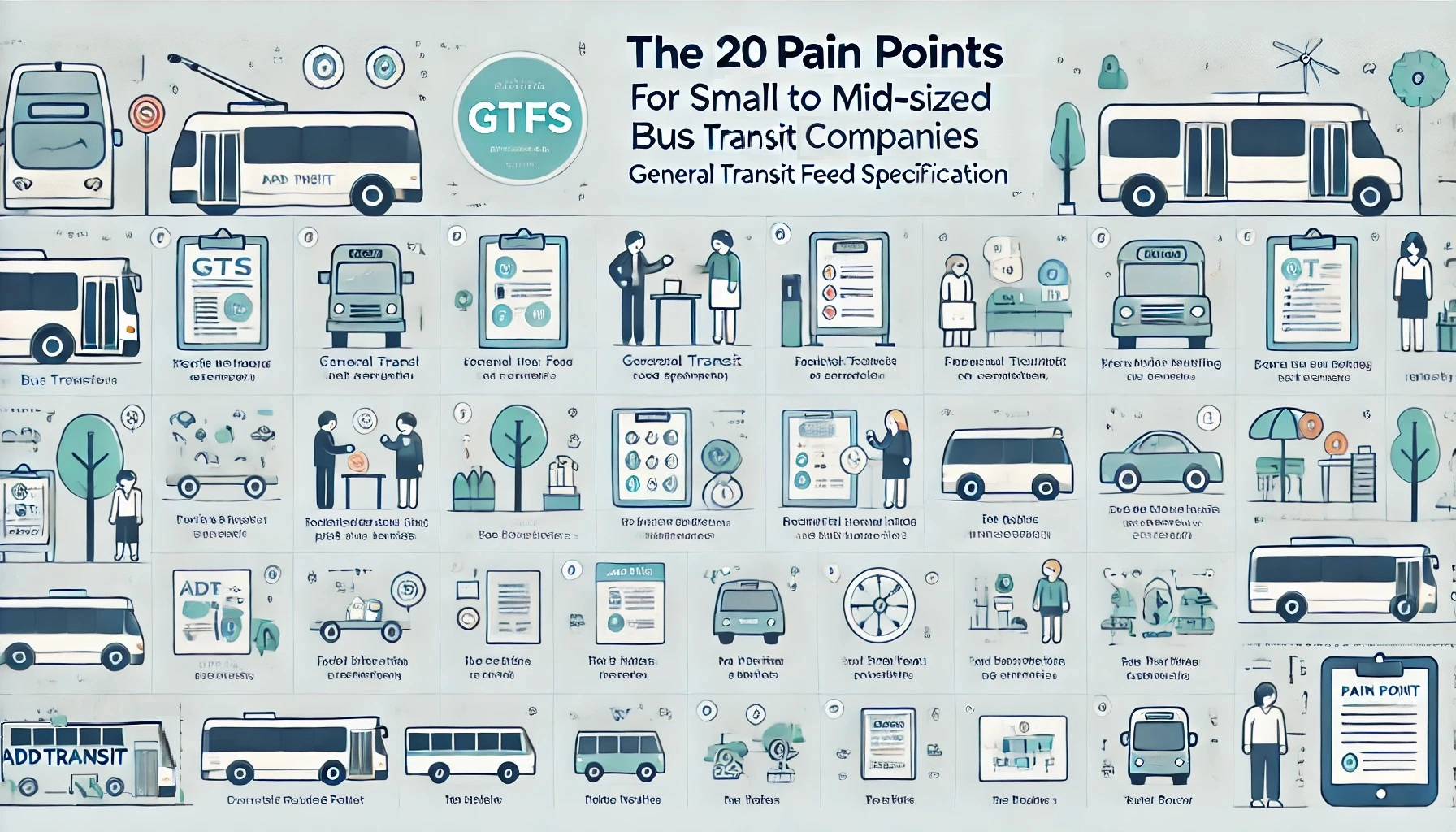
Graphic to article about twenty pain points for small to mid-sized bus & transit companies and how GTFS can help

The following table outlines 20 different pain points that small to mid-sized bus and coach operators experience in running and marketing their business and outlines how GTFS can help.

# Pain How GTFS Can Help
1 Inconsistent schedule information GTFS can provide accurate, standardized schedules for journey planners, ensuring consistency.
2 Difficulty in reaching more passengers GTFS data enables integration with popular journey planner apps like Google Maps, reaching a wider audience.
3 Poor route visibility GTFS allows routes to appear in online maps, improving route visibility for passengers.
4 Lack of real-time service updates Implement GTFS-RT (real-time extension) to provide real-time vehicle locations and delays.
5 Limited marketing resources Leveraging GTFS data in free journey planners reduces the need for traditional advertising.
6 Complexity in updating route changes GTFS simplifies the process of updating schedules and routes across multiple platforms.
7 High operating costs GTFS data analysis can identify underutilized routes, helping optimize operations.
8 Challenges in planning route expansions GTFS can be used to analyze passenger demand and optimize new route planning.
9 Poor service reliability due to traffic GTFS-RT can help by informing passengers of delays and updating journey times dynamically.
10 Difficulty in adapting schedules seasonally GTFS makes it easy to create seasonal variations in schedules and service levels.
11 Struggles with customer satisfaction Accurate GTFS data helps ensure passengers have reliable schedule information.
12 Regulatory compliance with data reporting GTFS formats may meet some local reporting requirements, reducing administrative workload.
13 Trouble integrating fare information GTFS supports fare information integration, making fare details accessible in journey planners.
14 Lack of data for decision-making Analyzing GTFS data can provide insights into route performance and passenger demand.
15 Inability to attract new customers Integrating GTFS data with trip planners can attract tech-savvy passengers.
16 Difficulty in handling service disruptions GTFS-RT can manage service alerts, notifying passengers of disruptions.
17 Limited options for providing ADA-compliant info GTFS allows encoding accessibility details like wheelchair access, improving compliance.
18 Unclear communication with passengers GTFS-RT service alerts can provide up-to-date notifications to passengers.
19 Inefficient route planning GTFS analysis can identify peak usage times, allowing for better route adjustments.
20 Fragmented passenger feedback Use GTFS data integration to analyze trip completion rates and identify areas for improvement.

Transform Pain Points into Success with AddTransit!

Tired of facing the same operational issues? AddTransit offers tailored solutions using GTFS, real-time tracking, and online ticketing to help your transit service overcome common challenges. Don’t let these pain points hold back your business—join today and see how our platform can streamline your operations and enhance your service.

Get Started with AddTransit Now

WordPress Journey Planner

We’ve made it easy for you to add a journey planner to your WordPress website.  Help your customers, increase patronage and reduce support costs by allowing potential passengers/visitors to “self serve”.

Here’s the Three easy steps.
1) Go to the WordPress page/post where you want to add the journey planner
2) Click on “Text”
3) Copy and Paste the following code where you want the journey planner to appear

<object data=”https://addtransit.com/journey-planner.php” width=”300″ height=”520″></object>

You’ll then get a Journey Planner added to the page, just like the one below.

Have a great day!


GTFS Tools – GTFS Builder, GTFS Editor and GTFS-Realtime

Getting your bus, train, ferry and public transport onto maps and apps requires GTFS Tools.  AddTransit has a set of GTFS tools that allows you start simply and then build up to more complex realtime updates.

GTFS Tools

Our GTFS tools include:

  • GTFS Builder / GTFS Editor
  • GTFS-Realtime Status updates
  • GTFS-Realtime Vehicle Tracking

Let’s discuss each of these in turn…..

GTFS Builder / GTFS Editor

GTFS Editor, GTFS Builder & other GTFS Tools

Our GTFS builder / GTFS editor allows you to create the initial GTFS file.   We step you through your agency details, the scheduled days that you operate, the routes, individual trips and stops information.  This allows you to easily build your GTFS file.  If you have existing data in stored in files (e.g. CSV, MS Excel), we even be able to upload the data for you and greatly speed up the creation of the GTFS file.  Once all the necessary information has been entered, then you can create your first GTFS file.  We can host the GTFS file for you, or you can host it on your own servers.  When your stops, routes or schedules change, you can easily log into our secure online website and use the GTFS Builder / GTFS editor to update your data.  When you are ready you can also add information about transfers, wheelchair and bike capacities, fares and route maps.

GTFS-Realtime Status Updates

GTFS-Realtime status updates

When delays affect a planned service, GTFS-Realtime status updates allow you to keep your passengers informed. You can provide customer information on what is causing the delay and what the effect will be on passenger’s travel.  The level of detail you provide is up to you. You can even provide a URL to pages on your company’s website to give even more detail.  AddTransit for GTFS-Realtime status updates can be provided to all online map, apps and journey planning providers.  This allows your passengers to choose their preferred devices and software providers.  Allowing your status updates to be displayed on many different online maps, apps and journey planners will result in the maximum number of customers being informed.

GTFS-Realtime Vehicle Tracking

GTFS-Realtime Vehicle Tracking

GTFS-Realtime Vehicle Tracking solves the problem of customers not knowing when their bus, train or ferry is about to arrive.  Using a free App on a GPS enabled smartphone with secure AddTransit login details, you can upgrade your AddTransit account to include GTFS-RealTime (GTFS-RT) Vehicle Tracking.  Initially, your staff can monitor your vehicles on the AddTransit website. When you are ready, you can also provide vehicle positions in a GTFS -Realtime file for all online map, apps and journey planning providers to use.

Related Posts:

https://addtransit.com/blog/tag/gtfs-editor/

Transit Driver Appreciation Day: Thank You From AddTransit!

Have you ever thought about how hard your bus driver works?  They might make the job look like it’s just tootling around all day, but bus drivers have to work hard, be constantly alert, and perform their duties with a smile.

Transit Driver Appreciation Day

Here are some of the ways bus drivers do an amazing job:

They Keep You Safe

According to research done in the EU, buses are the safest way to travel.  They are even safer than walking!  This is in large part due to the excellent training that bus drivers receive.  They have to pass difficult knowledge and driving tests, take medical exams, and continue to take classes throughout their careers to improve their driving.

Most people have had the experience of driving the family car with the distractions of passengers talking or kids crying.  Now imagine doing it with 30 passengers while handling a 40 foot, 27,000 pound vehicle!  Bus drivers must be intensely focused at all times to keep you safe on the road.


They Drive in All Weather

Some people might choose to take the bus in the winter when the weather is bad so they don’t have to drive.  But the bus drivers are still driving in that nasty weather!  Bus drivers work in rain, sleet, hail, snow, and high winds, at all times of day and night.  Not only do they have to make sure their own driving is safe, slow, and careful, they have to watch out for other drivers who are going too fast for the conditions.  People slide on the ice or pull right out in front of buses, and those buses don’t stop on a dime!  Bus drivers have to be extremely skilled to stay safe in winter weather conditions.


They’re Usually on Time (and when they’re not, it’s usually for a good reason!)

Bus drivers do an excellent job of running their routes on time.  Think about how difficult it is to time a trip.  You’ve been to the same grocery store or friend’s house or you kid’s school dozens, maybe hundreds of times, but do you know exactly, down to the minute, how long it takes to get there?  Most of us estimate, “Oh, it takes about 10 minutes,” then when we hit a little traffic, we’re 5 minutes late!

Bus drivers stay on track the majority of the time.  It’s frustrating when they are late, but consider the reasons.  They may have had to help someone in a wheelchair get on or off the bus at the last stop.  Maybe there was a car accident and they were held up in traffic.  Maybe an elderly passenger took a long time fishing change out of her purse.  Try to be patient with your bus driver when he or she is late, and consider all the times they have been on time despite constant fluctuations in the contributing factors.


Bus Drivers Deal with All Sorts of People

Sometimes passengers get angry at bus drivers for not having change, for fare increases or for being 30 seconds late.  Sometimes passengers are intoxicated and acting rowdy.  Some passengers harass other passengers, threaten other passengers or the driver, or bring weapons on the bus.  Bus drivers deal with all of this in a professional and firm, yet kind manner.  They have to make judgement calls about allowing potentially troublesome passengers on the bus and how to handle rule violations like standing in the front of the bus, and they have to do it in such a way that does not escalate a possibly dangerous situation.


Bus Drivers Do It All With a Smile

Even on less eventful days, bus drivers have to deal with hundreds of people in a polite and professional manner.  They say “hello” and “good morning” and “have a nice day” dozens of times.  They patiently help an elderly passenger up the steps, give a lollypop to an upset child, and listen to that one passenger’s story about his cats for the 300th time.  They remember the names and the faces and the usual stops of their regular passengers, and they help new passengers figure out the transit map.  And they do it all with a smile!


On this Transit Driver Appreciation Day, AddTransit wants to say THANK YOU to all the bus drivers around the world for doing their job well, keeping their passengers safe, and providing excellent customer service!

If you’d like a special way to say thank you to your bus driver, check out the Transit Driver Appreciation Day website.  They have thank you cards you can print.  You can also use the #tdad hashtag on social media and tag your bus or public transit company.

Transit News Roundup (March 3, 2016) – Latest Industry Updates

Every day we find transit news that is relevant and useful to you. But if you missed these daily posts on Facebook, Twitter, Google+, Pinterest and Linkedin, you can find them all here in one place each week!

Here’s what happened in the transit world last week:

Transit News for bus, train and ferry operators

BUSES & SCHOOL BUSES:

Retiree’s Last Bus Ride Home Leads to a Sweet Surprise

Angelo Fracassa has taken the bus to work for 60 years.  On his last day, his family and friends surprised him by joining him on the bus and taking him to a retirement party.

Franchised Bus Routes Could Reap $1Billion

The Tourism and Transport Forum Australia reports that franchising bus routes in certain cities could add $1billion to government revenue over 5 years.

Big Brother Buses?  Union, Bus Agency in Eavesdropping Fight

A legal battle is underway about whether surveillance of bus passengers can include audio recording.

Is Your Bus Company Ready for Mothering Sunday?

Mothering Sunday was on March 6th in the UK, and we provided some ideas for bus companies to make sure they’re ready for the increased traffic, have their schedules online, and are showing appreciation to the hard working mothers on their teams.

Making School Bus Time Fun and Safe

Ideas from the school bus safety program.

Kiss-Blowing Grandma Receives Birthday Surprise from Kids on School Bus

Doris Vehar greets the kids on the school bus every day when they come by her house.  This year, they surprised her on her birthday.

EPA Helps Schools Get Cleaner-Burning Buses

The US Environmental Protection Agency is granting funds to schools bus providers to help them replace or retrofit old diesel buses with greener models.

Transit News by AddTransit

READ ACROSS AMERICA DAY

Puttin’ On the Push for Read Across America Day

James Ojeda is a bus driver who’s been reading Dr. Suess books to kids for almost 20 years on Read Across America Day.

Reading Celebration Tried and True in Truro

Among some other tried and true ideas to make Read Across America Day a success, the Truro Public Library has had Thing 1 and Thing 2 from Dr. Suess’s famous book The Cat in the Hat meet kids at the bus.

TRAINS

Here’s How to Connect to Mumbai Central’s Free Public WiFi

Google is providing free public WiFi to the Mumbai Central train station, and they will roll out WiFi to 100 more rail stations this year.

A Brief Overview of Rail History in the Foothills Cities

Watch an interesting video about rail in the San Gabriel Valley.

TRANSIT TECHNOLOGY

Startup Makes Sense of Transit Data

The new company Urban Engines helps transit companies take the massive amounts of data from transit research and turn it into actionable plans.

Zonar Announces Key Leadership Changes to Support Rapid Growth and Business Development

Zonar is a leading transportation technology company, and they just brought on four new executives to support their growth.

PUBLIC TRANSIT

How San Francisco Got Its New Rider Friendly Transport Map

This new transit map is nice, but we think having an app on your phone is easier to read and more convenient.  What do you think?

The Astonishing Human Potential Wasted on Commutes

It takes the average commuter 26 minutes to get to work.  That adds up to 1.8 trillion minutes that Americans spend getting to and from work!  This includes both time spent in the car and on public transit, but we know from other research that taking the bus or train can often be faster than driving.  It’s also cheaper and more environmentally sustainable, and you can work, sleep or read while you commute.  So if you have to commute, take transit, and don’t let that time be wasted.

Commuters Could Save 1000 Pounds Per Year by Choosing Bus Over Car, Research Shows

Commuting by bus is 55% cheaper than by car.   That’s a lot of savings!

The Best Cities for Public Transportation

Cities in the US were ranked according to the commute time, the percentage of commuters who use transit, and the median income of transit users.  10 cities came out on top.  Check them out!

Take Transit to See Mum for Mothering Sunday

The UK has a lot of transit options for visiting Mum on Mothering Sunday or on any other day.  Whether you took the ferry, coach, undersea train, bus or rail, we hope you utilized the money saving option of traveling by transit this week.  If not, go see Mum today!  And take her for a train ride- she’ll love it!

The Car Century was a Mistake.  It’s Time to Move On.

Some cities are exploring the benefits of making certain areas car-free.  With exceptions for moving freight, this article explores the option of using streets as social spaces and providing good public transit.

Making Public Transportation Part of the Elections

With the US elections coming up, the APTA encourages voters to make their wishes known about public transit to their representatives by writing letters to the editor, using social media and contacting politicians directly.

Everything’s Riding on Forecasts for Transit Plans

City Councillors in Toronto are trying to decide which transit projects to fund.

HYPERLOOP

A New Mode of Transportation

Students from MUN are just one of many teams who are working on developing the hyperloop.

Simulation Driven Design Fast Tracks Hyperloop Development

Design teams are getting ready for the hyperloop race by testing parameters and designs virtually.

Hyperloop is the Perfect Way to Move Goods, Not People

While the hyperloop is undeniably a really awesome concept, some people think that it might be better for transporting freight.  What do you think?

Trial Bringing Into Open New Datasets for Smarter Travel in Home Counties

This project will make multi-modal transportation information available so app developers can make better transit apps.

What do you think about any of the articles or topics?  We’d love to hear from you!