
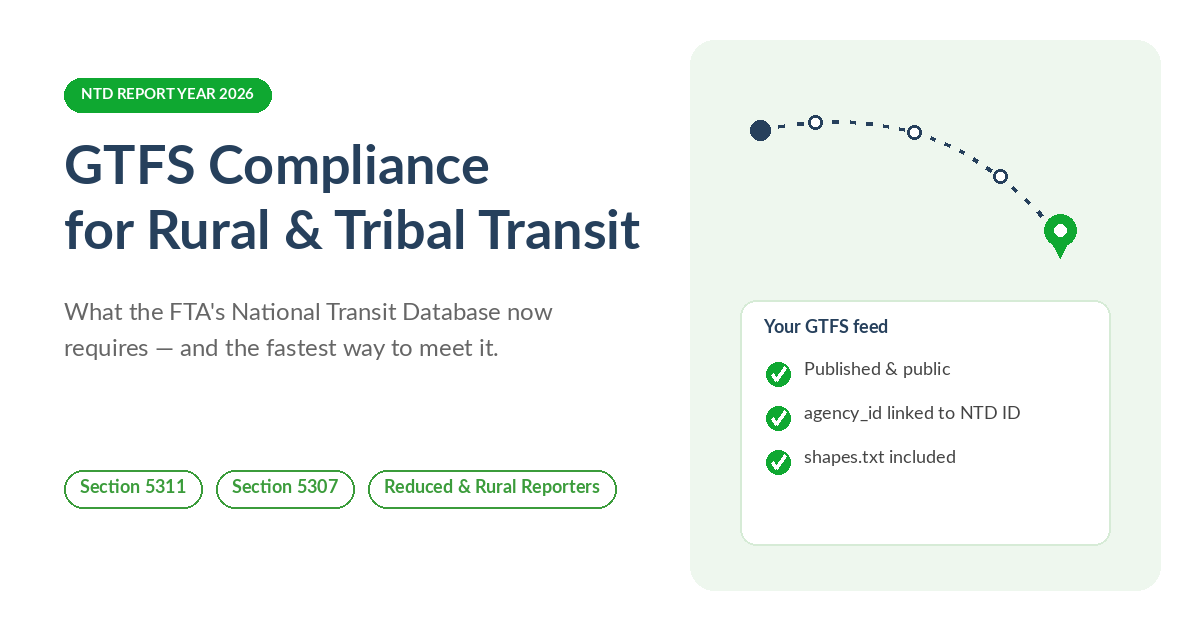
If you run a small public transit system in a rural county, or serve a tribal community, and your agency receives federal formula funding to do it, there is a compliance item landing this year that is easy to miss: the Federal Transit Administration’s National Transit Database (NTD) requires a public GTFS feed for your fixed-route service, and Report Year 2026 is when the newest technical requirements catch up with smaller reporters.
This is not a proposal or a “coming soon.” It is finalized. Here is what it actually says, what changed most recently, and what to do about it — whether or not you ever talk to us about it.
Who this applies to
If your agency is an NTD reporter — generally meaning you receive FTA Urbanized Area (Section 5307) or Rural Area (Section 5311) formula funding — and you operate any fixed-route service, including deviated fixed-route, then NTD requires a public, web-hosted static GTFS feed for that service, plus an annual certification that it is accurate. Demand-response-only operations are not on the hook for this particular requirement, though other NTD reporting rules still apply to them.
What changed for Report Year 2026
FTA finalized a batch of NTD reporting changes in a July 2025 Federal Register notice. Two of those changes tighten the existing GTFS requirement:
- Your feed’s
agency_idfield now needs to cross-walk to your agency’s NTD ID (matching the P-50 form). - Your feed needs a
shapes.txtfile — the actual route-line geometry your vehicles drive, not just a list of stops.
Both take effect in Report Year 2025 for full reporters, and Report Year 2026 for reduced, rural and tribal reporters. If your agency reports on that schedule, this reporting year is when it lands on you.
The parts that are easier than they sound
A few things about this requirement are more forgiving than the compliance-deadline framing suggests. Only a static GTFS feed is required — FTA’s own NTD FAQ confirms GTFS-Realtime is optional, not mandatory. A shared regional feed satisfies the requirement as long as it represents all of your reportable service, so if a regional planning body already publishes a combined feed that includes your routes, you may already be covered. And FTA does not expect same-day updates every time a stop moves or a detour happens — what’s actually asked for is an annual certification, as part of your NTD reporting package, that the feed is accurate.
The part that actually trips people up
Stops and routes are a spreadsheet problem. shapes.txt is not — it is the literal line your vehicle drives, point by point, and building it usually means separate GIS software that most one- or two-person transit offices don’t have sitting around. It’s the part of a hand-built feed that most often gets left out or fails validation the first time an agency puts one together.
Where AddTransit fits — and where it doesn’t need to
If your regional MPO or transit association already builds and hosts a GTFS feed that covers your service, you are likely already covered. This isn’t a requirement you need to buy software to satisfy.
If you’d rather not hand-build route geometry in a separate GIS tool, this is exactly the part AddTransit’s GTFS Editor is built to make easy: a built-in route/shape editor lets you draw or import your route, and AddTransit generates a valid shapes.txt from it — then validates and hosts the finished feed for $15 per route per month, no setup fee to start building. If your NTD deadline is close and you’d rather send us a timetable than build anything yourself, the Setup-as-a-Service Basic package ($199) covers the whole job: import, build, validate and publish.
We’ve put the fuller checklist — what’s required, what changed, and both paths through it — on one page: GTFS Compliance for Rural & Tribal Transit Agencies.
The short version
If you take FTA Section 5311 or 5307 formula money and run fixed-route service, you need a public GTFS feed, certified annually, and as of this reporting year that feed needs an NTD-ID-matched agency_id and a real shapes.txt. You can build all of that by hand, but the route-line geometry is where most first attempts stumble — and it’s exactly the part we’ve built AddTransit’s GTFS Editor to make simple.
This post is informational, not legal advice. Confirm your agency’s specific reporting obligations with your assigned NTD analyst.
